What Is a Prop Firm? How Funded Accounts Work (2026 Guide)
By Modestas R. · Updated · 8 min read
A proprietary trading firm, or prop firm, lets you trade a larger account than you could fund yourself and keep most of the profit. Today's retail prop firms work very differently from the trading desks the name comes from: you pay for an evaluation, prove you can follow the rules, then trade a funded account and get paid a share of what you make. This guide explains how that works, what it costs, how prop firms make money and how to tell a solid firm from a risky one.
What is a prop firm?
A prop firm is a company that provides trading capital, or access to a funded account, in exchange for a share of the profits. The term comes from proprietary trading: banks and trading houses trading their own money rather than clients'. Those firms hire traders, give them a desk and capital, and pay them a share of profits.
Retail prop firms, sometimes called funded trader programs, open that model to anyone online. Instead of a job interview, you take an evaluation (also called a challenge, combine or test). Instead of a desk, you trade from home on a platform such as NinjaTrader, Tradovate or TradingView. This guide focuses on futures prop firms, which trade CME products such as the E-mini S&P 500 (ES) and Nasdaq (NQ) and their micro contracts.
How do prop firms work?
Almost every futures prop firm follows the same path:
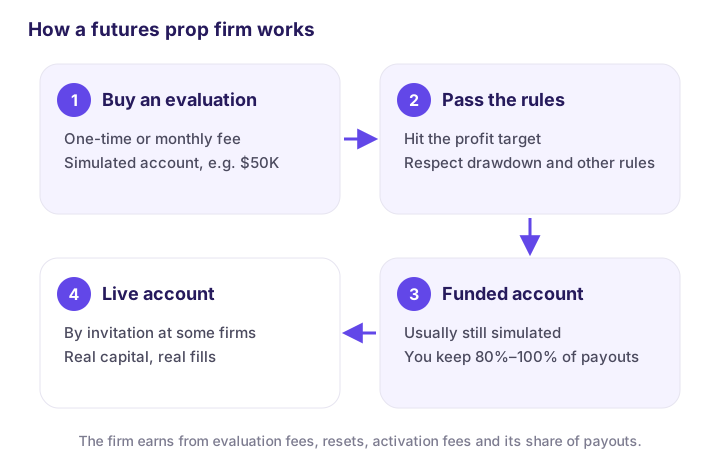
- Buy an evaluation. You pick an account size, for example $50,000, and pay a one-time or monthly fee.
- Pass the rules. On a simulated account, reach the profit target (usually $3,000 on 50K) without breaking the drawdown and the other rules.
- Trade a funded account. You trade with the same kind of rules, request payouts and keep most of the profit. Some firms charge an activation fee at this point.
- Move to a live account. Some firms invite their most consistent traders to trade real capital, usually with fewer restrictions and no payout caps.
What is a funded account in trading?
A funded account is the account you trade after passing the evaluation. Its profits are paid to you, minus the firm's share. Firms give it their own names: the Express Funded Account at Topstep, the Performance Account at Apex, PRO at Take Profit Trader or the Sim Funded account at My Funded Futures and Tradeify.
The most important detail: most funded accounts are simulated. Your trades don't reach the exchange, but the firm pays you real money based on your simulated results. That is how firms can offer large accounts for a small fee. Real capital usually comes later, if at all, through invitation-only live programs such as Topstep's Live Funded Account, Take Profit Trader's PRO+ or Apex Live.
How do funded accounts work?
A funded account keeps rules similar to the evaluation and adds rules for withdrawing money. On a typical 50K futures account in 2026:
| Rule | What it means | Typical range on 50K |
|---|---|---|
| Profit target | Profit needed to pass the evaluation | $2,500 to $3,000 |
| Maximum drawdown | How far the account can fall before it fails; usually trailing | $1,500 to $2,000 |
| Daily loss limit | A separate cap on one day's loss, if any | None to $1,000 |
| Consistency rule | Limits how much profit can come from one day | None to 50% of profit |
| Time limit | Time allowed to pass | None at most firms; 30 days at Apex |
| Profit split | Your share of approved payouts | 80% to 100% |
| Payout schedule | How often you can withdraw | Daily to every 5 winning days |
Two rules cause most failures. The drawdown decides whether the account survives, and it often trails your highest balance; read trailing drawdown explained. The consistency rule decides when you can pass or get paid; read the consistency rule.
Payouts also come with conditions: a minimum number of winning days, a buffer above the drawdown before the first withdrawal, a cap per payout and sometimes a limit on the number of payouts. Apex, for example, pays 100% of approved payouts but closes a Performance Account after six; FundedNext accounts conclude after five rewards.
How do prop firms make money?
Prop firms earn from four sources:
- Evaluation fees, one-time or monthly, from every trader who signs up.
- Resets, when traders pay to restart a failed evaluation.
- Activation fees, charged by some firms when you pass.
- Their share of payouts, usually 10% to 20% of funded profits (Apex takes none in its Performance Account).
Because most traders don't pass, evaluation fees are a large share of the business. Two firms we review publish their numbers: Take Profit Trader reported that 20.37% of its registered users passed a test between January and August 2023, and TradeDay states that 36% of traders passed its evaluation from January to June 2026.
That is not a reason to avoid prop firms, but it is a reason to choose one with clear, fair rules, and to treat each evaluation fee as a cost you may not get back.
What does a prop firm cost?
The headline price is only part of the cost. Here is what getting a 50K funded account cost at four firms we review, at list prices on October 25, 2026:
| Firm | Evaluation | Activation fee | Reset | Billing |
|---|---|---|---|---|
| Topstep | $49 per month | $149 (or $95 a month with no activation fee) | $49 | Monthly until you pass |
| Tradeify Select | $165 | None | $109 | One-time |
| Apex Trader Funding Intraday | $249 | $99 | New evaluation | One-time, 30 days |
| FTMO Futures Growth | $119 per month | None | $109 | Monthly until you pass |
Most firms also run discount codes, some almost permanently, so the price you pay can be far lower. Our comparisons show both list prices and prices with each firm's own code.
Also budget for:
- Several attempts. With published pass rates of about 20% and 36%, plan for more than one evaluation.
- Data fees on live accounts. Simulated accounts often include basic market data, but live traders can pay professional data fees; TradeDay lists $156 a month per exchange.
- Payout fees. Some firms charge for certain withdrawal methods, such as Topstep's $30 for ACH and wire.
Are prop firms and funded accounts legit?
Many prop firms are legitimate businesses that pay traders every day, but the industry is young, lightly regulated and firms come and go. Signs of a firm you can trust:
- A verifiable track record. Topstep has run its Trading Combine since 2012 and FTMO since 2015. Newer firms aren't automatically bad, but they have less history to judge.
- Public, detailed rules. A help center that explains every rule with examples, so nothing is decided after the fact.
- Clear payout terms. Published splits, caps, schedules and payout methods, plus identity checks (KYC) before you are paid.
- Honesty about simulation. The firm says plainly that evaluations and funded accounts are simulated and explains how live accounts work.
- Consistent data. Prices and rules that match across the website, checkout and help center.
Red flags include rules that are vague or missing, payout terms that change without notice, and promises of guaranteed income. Evaluation fees are generally not refundable, so read the terms before you buy.
How to choose a prop firm
Match the rules to how you trade:
- Drawdown type: end-of-day drawdowns suit traders who let winners run; intraday drawdowns suit quick scalpers.
- Consistency rule: if you often have one big day, pick a plan without an evaluation consistency rule.
- Platform: make sure the firm supports the software you already use.
- Payouts: check how soon and how often you can withdraw, and the caps.
- Total cost: compare the cost to get funded, including activation fees and likely resets, not just the evaluation price.
Our prop firm comparison puts these side by side, and our methodology explains how we score each firm.
Is prop trading worth it?
Prop trading lets you trade a larger account with a known, capped cost, and keep most of the profit if you succeed. The trade-offs are strict rules, simulated accounts and fees that add up if you fail repeatedly.
It is worth it if you already trade with a tested plan and the discipline to follow rules, and you treat evaluation fees as a business expense. It is not a shortcut to income for beginners. If you are new, practice on a demo account until you can respect a daily loss limit and a drawdown for weeks at a time, then pick a firm whose rules fit your style.
Frequently asked questions
Do prop firms give you real money?+
They pay you real money, but most funded accounts are simulated: your trades do not reach the exchange, and the firm pays you a share of your simulated profits. Some firms later invite consistent traders to live accounts that trade real capital.
How much does it cost to get a funded account?+
At list prices on October 25, 2026, a 50K futures evaluation cost $49 a month at Topstep, $119 a month at FTMO Futures and a one-time $165 at Tradeify, and some firms add an activation fee of around $100 to $150 when you pass. Many firms run discount codes, and most traders need more than one attempt.
Can you lose more than the evaluation fee?+
No. On evaluation and funded accounts, your cost is limited to the fees you pay. If you break the drawdown, the account closes; trading losses are not charged to you.
How do prop firms make money?+
From evaluation fees, resets, activation fees and their share of funded traders' profits, usually 10% to 20%. Because most traders do not pass, evaluation fees are a large part of the business.
What percentage of traders pass a prop firm challenge?+
Few firms publish it. Take Profit Trader reported that 20.37% of its registered users passed a test between January and August 2023, and TradeDay states that 36% of traders passed its evaluation from January to June 2026.
Are funded accounts legit?+
Many prop firms are legitimate and pay traders every day, but the industry is lightly regulated. Look for a verifiable track record, detailed public rules, clear payout terms with identity checks, and honesty about simulated accounts before you buy.
This guide is for education only and is not financial advice. Rules differ between prop firms and change over time; always check the firm's current terms before you buy a challenge.