Trailing Drawdown Explained: EOD vs Intraday vs Static
By Modestas R. · Updated · 10 min read
The drawdown rule ends more prop firm accounts than any other rule. Profit targets get the attention, but it is the maximum drawdown that decides whether your evaluation or funded account survives a bad day. This guide explains what a trailing drawdown is, how end-of-day (EOD), intraday and static drawdowns differ, and how the futures prop firms we review apply them.
What is drawdown at a prop firm?
At a prop firm, drawdown is the maximum amount your account is allowed to lose before it is closed. Firms give it different names, such as the Maximum Loss Limit at Topstep, the max loss limit (MLL) at My Funded Futures or the trailing threshold at Apex, but the idea is the same.
It is set as a dollar amount. On a $50,000 account with a $2,000 drawdown, the starting liquidation threshold is $48,000. If your account equity touches that level, the evaluation or funded account fails. Most 50K futures evaluations we review use a $2,000 drawdown; FundedNext's 50K Flex uses $1,500.
What makes prop firm drawdown tricky is that the threshold usually moves up as you make money. That is what "trailing" means.
What is a trailing drawdown?
A trailing drawdown follows your account's highest balance, always staying the same distance below it. When you make a new high, the threshold rises by the same amount. When you lose, it stays where it is.
| Event ($50K account, $2,000 drawdown) | Highest balance | Liquidation threshold | Room left |
|---|---|---|---|
| Start | $50,000 | $48,000 | $2,000 |
| Day 1: +$800 | $50,800 | $48,800 | $2,000 |
| Day 2: −$400 | $50,800 | $48,800 | $1,600 |
| Day 3: +$900 | $51,300 | $49,300 | $2,000 |
| Day 4: +$800 | $52,100 | $50,000 (stops trailing) | $2,100 |
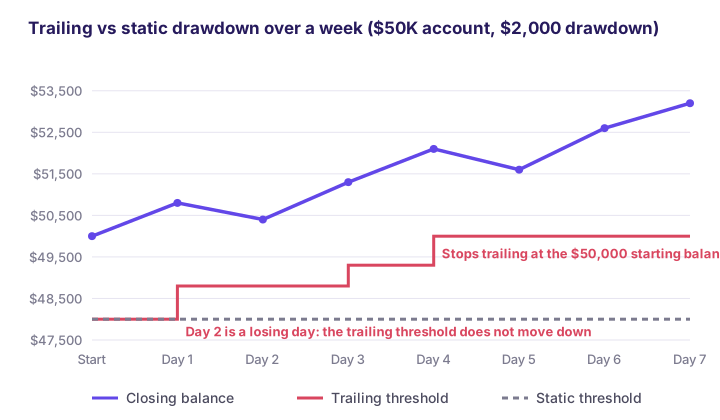
Notice two things. A losing day never moves the threshold back down, so your room shrinks after a loss. And once your profit is larger than the drawdown, the threshold stops at the starting balance, which brings us to the most important detail of any trailing drawdown.
When does a trailing drawdown stop trailing?
Almost every firm stops trailing once the threshold reaches the starting balance, or the starting balance plus a small buffer. From then on, the drawdown behaves like a static limit, and every extra dollar of profit is extra room. Exactly where it stops differs:
- Take Profit Trader and FTMO Futures: at the starting balance ($50,000 on a 50K account).
- FundedNext Futures: at the starting balance plus $100.
- My Funded Futures: funded accounts start at a $0 balance and the limit locks at $100, so you must always keep at least $100 in the account.
- Apex Trader Funding: an intraday threshold in the Performance Account stops trailing once your profit reaches the drawdown amount plus $100.
- Alpha Futures: at the starting balance, and withdrawals do not move it back up.
This is why the first $2,000 or so of profit on a funded account matters so much: until the threshold locks, one bad session can end the account.
What is an EOD trailing drawdown?
An end-of-day (EOD) trailing drawdown only updates at the close of each trading session, using your closing balance. During the day, the threshold stays fixed.
Example: on a $50,000 account with a $2,000 EOD drawdown, you are up $1,200 mid-session, give back $800 and close up $400. The threshold only trails the $400 you kept and moves from $48,000 to $48,400. Intraday swings in open profit do not tighten it.
What to watch: the EOD threshold is updated once a day, but it is enforced in real time. At Apex, FTMO, Tradeify, FundedNext and Take Profit Trader, for example, if your equity touches the current threshold during the session, including on an open loss, the account fails.
EOD is the most common type among the firms we review. Topstep, Tradeify, FTMO Futures, FundedNext Futures and Alpha Futures use it in both the evaluation and the funded account.
What is an intraday trailing drawdown?
An intraday trailing drawdown (also called real-time trailing) follows your highest balance including unrealized profit, tick by tick.
Example: you open a trade on a $50,000 account with a $2,000 intraday drawdown. The trade runs up $1,500 in open profit, so the threshold moves to $49,500. The trade then reverses and you close it at break-even. Your balance is back to $50,000, but the threshold stays at $49,500, so you now have only $500 of room left. With an EOD drawdown, you would still have $2,000.
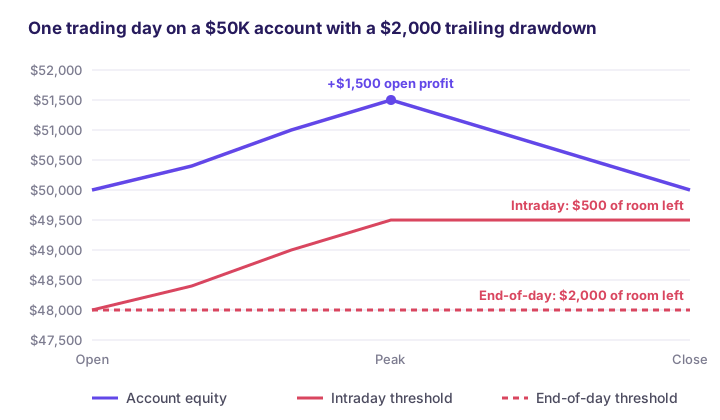
This is why intraday drawdown punishes trades that run in your favor and then come back. It suits traders who take profits quickly and move stops to break-even early. Firms often make intraday accounts cheaper: Apex's 50K Intraday Trail evaluation lists at $249, against $590 for its EOD Trail.
Several firms switch to an intraday drawdown after you pass, even when the evaluation was end-of-day: Take Profit Trader's PRO account, My Funded Futures' Rapid plan and TradeDay's Quick Pay funded accounts all do. Check the funded rules, not just the evaluation.
EOD vs intraday drawdown: which is better?
| End-of-day (EOD) | Intraday | Static | |
|---|---|---|---|
| Threshold updates | Once a day, from the closing balance | In real time, including open profit | Never |
| Open profit you give back | Doesn't move the threshold | Moves the threshold up | Doesn't move the threshold |
| Enforced | In real time | In real time | In real time |
| Typical price | Higher | Lower | Usually smaller drawdown or higher price |
| Suits | Traders who let winners run | Scalpers with quick exits | Most traders |
For most traders, EOD is the better choice, because it judges you on what you keep, not on open profit you never banked. Intraday can still make sense if you scalp with tight stops and want a cheaper evaluation. Whichever you choose, check whether the firm stops trailing at the starting balance and whether a separate daily loss limit applies on top.
What is a static drawdown?
A static drawdown never moves. On a $50,000 account with a $2,000 static drawdown, the threshold is $48,000 for the life of the account, no matter how much you make.
Static drawdown is the most forgiving type, so firms that offer it usually make it small or charge more. Phidias' 50K Express to Live account, for example, uses a static drawdown that liquidates the account at $49,350, only $650 below the start. My Funded Futures sells small static-drawdown Studio accounts, and its Pro plan turns the drawdown static after your first payout. Live accounts at Topstep and My Funded Futures also use a static drawdown.
Trailing drawdown vs daily loss limit
A daily loss limit is a separate rule that caps how much you can lose in one session. It sits on top of the maximum drawdown, and how strict it is depends on the firm:
- Soft limits pause trading for the rest of the day: Apex's EOD Trail evaluation ($1,000 on 50K), Tradeify's Growth evaluation and FTMO's Growth funded account.
- Hard limits fail the account: FTMO's Pro plan, for example.
- Optional limits: Topstep lets you choose a $1,000–$3,000 daily loss limit at checkout, or none.
Many popular plans have no daily loss limit at all, including Take Profit Trader, Tradeify Select, My Funded Futures Rapid and FundedNext Flex.
Drawdown and the payout buffer
Once funded, many firms make you build a buffer above the drawdown before your first payout, so a withdrawal cannot push you straight into the threshold. On a 50K account:
| Firm and plan | Before your first payout |
|---|---|
| Take Profit Trader PRO | Balance above $52,000 |
| My Funded Futures Rapid | $2,100 of profit |
| FundedNext Rapid Daily | End-of-day balance above $52,100 |
| Apex Performance Account | Balance above the drawdown plus $100, plus the $500 minimum payout: $52,600 |
The buffer is roughly the size of the drawdown, which is also the point at which most thresholds stop trailing.
Drawdown rules by prop firm
How the futures prop firms we review apply drawdown on their main plans, as checked on October 25, 2026:
| Firm | Evaluation drawdown | Funded drawdown |
|---|---|---|
| Alpha Futures | EOD | EOD, not moved by withdrawals |
| Apex Trader Funding | EOD or intraday (your choice) | Same type as the evaluation |
| Blue Guardian Futures | EOD | EOD |
| E8 Futures | EOD | EOD |
| FTMO Futures | EOD | EOD, locks at the starting balance |
| FundedNext Futures | EOD | EOD, locks at the starting balance plus $100 |
| FuturesElite | EOD | EOD; intraday on Nitro |
| Goat Funded Futures | EOD | EOD; intraday on Daily Payouts and Instant Classic |
| My Funded Futures | EOD | Intraday on Rapid; EOD on Rapid EOD and Builder; static after the first payout on Pro |
| Phidias | Static (Express to Live) or EOD | Static (Express to Live) or EOD |
| Take Profit Trader | EOD | Intraday in PRO; EOD in live PRO+ |
| Top One Futures | EOD | EOD; intraday on Elite Access Intraday |
| Topstep | EOD | EOD; static on the Live Funded Account |
| TradeDay | Intraday or EOD (Quick Pay), EOD (Fast Pass) | Intraday on Quick Pay, EOD on Fast Pass |
| Tradeify | EOD | EOD |
Want to compare two firms directly? See Topstep vs Apex, Apex vs Tradeify or all our comparisons.
How to protect your drawdown
- Know your threshold before every session. Write down the exact level, not just the drawdown amount.
- Size positions to your remaining room, not to the account size. If a full stop-loss would use more than a quarter of your room, trade smaller. Our futures position size calculator does the math from your drawdown and stop.
- On an intraday drawdown, protect open profit early. Move stops to break-even or take partial profits, because every tick of open profit raises the threshold.
- Set your own daily stop well before any daily loss limit, and stop trading when you hit it.
- Aim to lock the threshold. Once your profit exceeds the drawdown and the threshold stops trailing, you can trade with much less pressure.
The drawdown is only one rule. Read how the consistency rule can delay a pass or payout, or start with what a prop firm is and how funded accounts work.
Frequently asked questions
What is a trailing drawdown in trading?+
A trailing drawdown is a maximum loss limit that moves up as your account makes new highs and never moves back down. On a $50,000 account with a $2,000 trailing drawdown, the limit starts at $48,000 and rises to $49,000 when your balance reaches $51,000. Most prop firms stop trailing once the limit reaches the starting balance.
What does EOD drawdown mean?+
EOD stands for end-of-day. An EOD trailing drawdown only moves up from your closing balance at the end of each session, so open profit you give back during the day does not tighten it. The limit is still enforced during the day: if your equity touches it, even on an open loss, the account fails.
Is EOD or intraday drawdown better?+
For most traders, EOD is better because it judges you on the profit you keep at the close. An intraday drawdown follows open profit in real time, so a trade that runs up and comes back can use most of your room. Intraday accounts are often cheaper and can suit scalpers who take profits quickly.
Does unrealized profit count toward the drawdown?+
With an intraday trailing drawdown, yes: the limit follows your highest balance including open profit. With an EOD drawdown, open profit does not move the limit, but open losses still count, so an open trade can breach it during the day.
Does a trailing drawdown ever stop?+
Usually yes. Most futures prop firms stop trailing once the limit reaches the starting balance or the starting balance plus about $100. From then on it works like a static limit, and any further profit adds to your room.
What is the difference between trailing and static drawdown?+
A trailing drawdown rises with your highest balance; a static drawdown stays at the same level for the life of the account. Static drawdowns are more forgiving, so firms that offer them usually make them smaller or charge more.
This guide is for education only and is not financial advice. Rules differ between prop firms and change over time; always check the firm's current terms before you buy a challenge.