Prop Firm Consistency Rule Explained: 50%, 40% and 30% Rules
By Modestas R. · Updated · 10 min read
Many traders reach the profit target without touching the drawdown, then find they cannot pass or get paid because of the consistency rule. This guide explains what the rule is, the three ways prop firms calculate it, what a 50%, 40% or 30% consistency rule means in dollars, and which futures prop firms let you trade without one.
What is a consistency rule?
A consistency rule limits how much of your profit can come from one trading day. Prop firms use it to make sure a pass or a payout reflects repeatable trading rather than one lucky day, often one oversized trade.
It is written as a percentage, for example: "Your best day must be less than 50% of your total profit." The lower the percentage, the stricter the rule and the more trading days you need.
How is the consistency rule calculated?
The basic formula compares your best day with your profit:
Consistency % = Best day profit ÷ Profit
To find the profit you need for a given best day, turn it around:
Profit needed = Best day profit ÷ Rule %
What differs between firms is which profit goes in the formula:
| Method | What your best day is compared with | Examples (checked October 25, 2026) |
|---|---|---|
| Share of total profit | All net profit on the account | Take Profit Trader Test (50%), Tradeify Select (40%), FTMO Futures (40% or 50%), TradeDay (30% or 45%) |
| Share of the profit target | The profit target, not what you made | Topstep Trading Combine (55%), FundedNext Flex (40%) |
| Share of profit since the last payout | Profit in the current payout cycle | Apex Performance Account (50%), Alpha Futures funded Zero and Standard (40%) |
The target-based method is the easiest to plan for, because the limit is a fixed dollar amount: below 55% of a $3,000 target at Topstep means a best day under $1,650. With the other two methods, the limit grows as your profit grows.
Consistency rule example
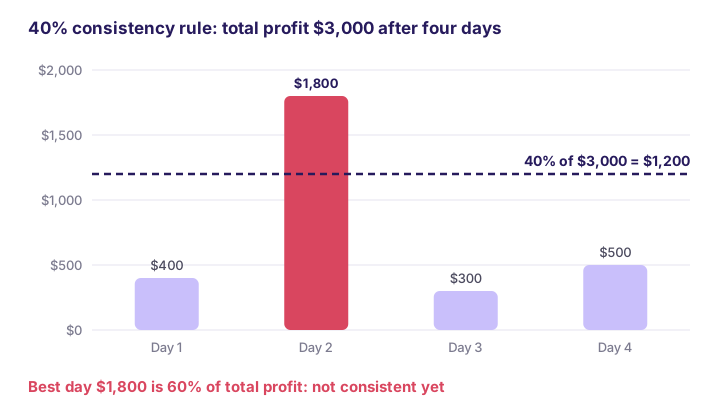
Here is a 40% rule based on total profit, on a 50K account with a $3,000 target:
| Day | Profit |
|---|---|
| Day 1 | $400 |
| Day 2 | $1,800 |
| Day 3 | $300 |
| Day 4 | $500 |
| Total | $3,000 |
You have hit the target, but your best day is $1,800 ÷ $3,000 = 60% of your profit, above the 40% limit.
To meet the rule you need $1,800 ÷ 0.40 = $4,500 in total profit, so another $1,500 on days smaller than your best day. Three more days of $500 do it:
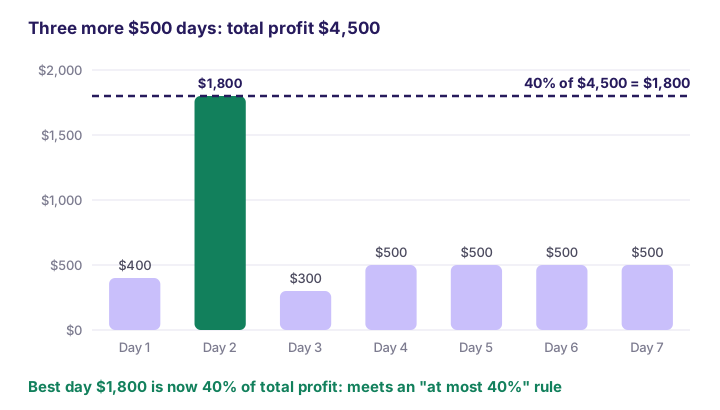
Watch the wording. "At most 40%" (FTMO) is met at exactly 40%; "less than 50%" (Take Profit Trader) is not met at exactly 50%.
Want to check your own days? Our free consistency rule calculator has every firm's rule built in and shows the biggest day you can make without breaking it.
What does a 50% consistency rule mean?
A 50% consistency rule means your best day must be less than half of your profit. In practice:
- You need at least two trading days, because one day would be 100% of your profit.
- On a $3,000 target, keep your best day under $1,500 to pass right at the target.
- If your best day is $2,000, you need more than $4,000 in total profit.
Take Profit Trader's Test, My Funded Futures' Rapid evaluation and Alpha Futures' Standard evaluation use 50% of total profit. Apex uses 50% of profit since your last payout before each Performance Account payout.
What does a 40% consistency rule mean?
A 40% consistency rule means your best day can be no more than 40% of your profit, so you need at least three trading days.
- On a $3,000 target, keep your best day at or below $1,200.
- If your best day is $1,800, you need $4,500 in total profit.
Tradeify's Select evaluation and FTMO Futures' Growth Evaluation use 40% of total profit. FundedNext Flex uses 40% of the target: no day above $1,000 on its $2,500 50K target. Alpha Futures applies 40% to profit since your last withdrawal on funded Zero and Standard accounts.
30% and 20% consistency rules
Stricter rules need more days:
- 30% means at least four trading days. On a $3,000 target, your best day must stay at or below about $900. TradeDay's Quick Pay evaluation and My Funded Futures' Rapid EOD evaluation use 30%, and Phidias applies 30% on funded Fundamental and Premium CASH accounts.
- 20% means at least five trading days. It is common on accounts that skip the evaluation: FundedNext's Direct Account, Alpha Futures' Direct account and Blue Guardian's Direct plan, and the first payout on Tradeify's Lightning Funded account.
Evaluation vs funded consistency rules
The same firm can apply different rules at each stage, and the stage matters more than the percentage:
- Evaluation only: the rule decides when you pass, then disappears. Tradeify Select, FTMO Futures and E8 Zero work this way.
- Funded only: you can pass in a day, but each payout needs consistent days. Apex, Blue Guardian Standard and Top One Elite Access work this way.
- Both stages: Alpha Futures Standard uses 50% in the evaluation and 40% once funded.
What happens if you break the consistency rule?
At most firms, breaking it does not fail your account:
- In the evaluation, your profit target effectively rises. At Topstep the target becomes your best day ÷ 0.55; at Take Profit Trader, TradeDay and FundedNext Flex your goal rises in the same way; at FTMO you keep trading until your best day falls under the limit.
- On a funded account, the payout request is blocked until enough profit dilutes your best day. Apex states clearly that this blocks the request but does not fail the account.
The real danger is behavioral. After a big day, traders often take larger risks to "catch up" on the profit they still need, and hit the drawdown limit instead.
Prop firms without a consistency rule
If you would rather not deal with a consistency rule, these are the options among the futures prop firms we review, as checked on October 25, 2026. For the full plan-by-plan list, including forex firms and instant accounts, see prop firms without a consistency rule.
No consistency rule at any stage:
- FundedNext Futures Rapid Daily
- Phidias Express to Live
No consistency rule in the evaluation (you can pass in one day, but a rule may apply to payouts):
- Apex Trader Funding, all evaluations
- Tradeify Growth, My Funded Futures Builder and Alpha Futures Zero
- FundedNext Futures Rapid Pro and Rapid Daily
- Top One Futures Elite Access, Blue Guardian Futures Standard, FuturesElite Prime, E8 Futures Signature and Goat Funded Futures 1-Day-Pass
- Phidias, all evaluations
No consistency rule once funded:
- Tradeify Select and FTMO Futures
- My Funded Futures Rapid and Pro, and Alpha Futures Advanced
- FundedNext Futures Flex and Topstep on its Standard payout path
- Blue Guardian Futures Reserve and Express, FuturesElite Elite and Nitro, E8 Futures Zero, Top One Futures Elite Daily and Goat Funded Futures Flex and Daily Payouts
A plan without a consistency rule is not automatically easier. Firms often balance it with a daily loss limit, a smaller payout cap or an intraday drawdown, so compare the whole rule set.
Consistency rules by prop firm
Every futures prop firm we review, with its rule in full:
- Alpha Futures
- Evaluation: none on Zero, 50% on Standard, 40% on Advanced. Funded: 40% on Zero and Standard (best day under 40% of profit since the last withdrawal), none on Advanced, 20% on Direct.
- Apex Trader Funding
- No consistency rule in the evaluation. In the Performance Account, to request a payout your largest profitable day must be less than 50% of net profit since the last approved payout (best day ÷ 0.5 = profit needed).
- Blue Guardian Futures
- Standard: none in the evaluation, 40% on the funded account. Reserve: 50% in the evaluation (40% with a cheaper add-on), none once funded. Express: 40% in the evaluation only. Direct: 20% to request payouts.
- E8 Futures
- E8 Signature: no consistency rule in the challenge, 35% best-day rule for payouts. E8 Zero: 40% best-day rule in the challenge only, none once funded.
- FTMO Futures
- Evaluation only: your best day may be at most 40% (Growth) or 50% (Pro) of total profit. Going over is not a breach; you keep trading until the share falls. There is no consistency rule on the Sim-Funded Account.
- FundedNext Futures
- Flex Challenge: no day above 40% of the profit target, or the target rises to best day ÷ 0.4. Rapid Pro funded account: best day must be 40% or less of total profit before a withdrawal. Direct Account: 20% perpetual consistency. Rapid Daily has none.
- FuturesElite
- Elite: 40% or 50% in the evaluation (chosen at checkout), none once funded. Nitro: 50% in the evaluation, none once funded. Prime: none in the evaluation, 40% of each payout request when funded. Instant: 20%, then 25%, then 30%.
- Goat Funded Futures
- Evaluation: 50% on EOD and Flex, 40% on Daily Payouts, none on 1-Day-Pass. Funded: 30% on EOD, 35% on 1-Day-Pass, 20% on Instant Classic, none on Flex or Daily Payouts.
- My Funded Futures
- Most evaluations use a 50% consistency rule (30% on Rapid EOD); Builder has none in evaluation but 50% for payouts. Rapid and Pro have no consistency rule once funded.
- Phidias Propfirm
- No consistency rule in evaluations or on Express to Live accounts. On funded Fundamental and Premium CASH accounts, no single day may exceed 30% of total profit (calculated over at least 4 trading days).
- Take Profit Trader
- During the test, your best day must be less than 50% of total net profit. If it is not, your profit goal rises to more than twice your best day.
- Top One Futures
- Elite Access: none in the evaluation, 40% on the funded account (largest day at most 40% of the cycle's profit). Elite Daily: 40% in the evaluation only. Instant Sim Funded: 20%. Ignite: 15%.
- Topstep
- In the Trading Combine your best day must stay below 55% of the profit target; if it goes higher, the target rises to best day ÷ 0.55. On the XFA Consistency payout path, your largest day must be 40% or less of net profit since the last payout.
- TradeDay
- In the evaluation, no single day may exceed 30% (Quick Pay) or 45% (Fast Pass) of total profit; a bigger day does not fail you, your profit goal rises instead. Fast Pass accounts opened from July 26, 2026 also need the 45% rule before each payout. Quick Pay payouts have no consistency rule.
- Tradeify
- Select: 40% in the evaluation only (50% with an add-on), none once funded. Growth: none in the evaluation, 35% for funded payouts. Lightning: 20%, then 25%, then 30% for later payouts.
Checked against each firm's official help center on October 25, 2026.
How to pass with a consistency rule
- Turn the rule into a daily cap. Multiply the rule by your target: 40% of $3,000 is $1,200. Stop for the day when you reach it.
- Track your best day. Keep a simple log of each day's profit, your best day and the profit you need (best day ÷ rule).
- Check which profit counts. Total profit, the target or profit since your last payout give very different numbers.
- Don't force trades after a big day. Normal-sized days will dilute it; oversized ones risk the drawdown.
- Pick a plan that fits. If you often have one big day a week, a plan without an evaluation consistency rule, or with 50% instead of 40%, will suit you better.
Compare rules side by side in our prop firm comparison, or read what a prop firm is and how funded accounts work.
Frequently asked questions
What is a consistency rule in trading?+
A consistency rule limits how much of your profit can come from your best single trading day. For example, a 40% rule means no single day may make up more than 40% of your profit. Prop firms use it to make sure a pass or payout reflects repeatable trading rather than one lucky day.
What does a 50% consistency rule mean?+
Your best day must be less than half of your profit. On a $3,000 profit target that means a best day under $1,500, and you need at least two trading days. If your best day is $2,000, you need more than $4,000 in total profit.
What does a 40% consistency rule mean?+
Your best day can be no more than 40% of your profit, so you need at least three trading days. On a $3,000 target your best day should stay at or below $1,200. With an $1,800 best day you need $4,500 in total profit.
How do I calculate the profit I need?+
Divide your best day by the rule. With a $1,500 best day and a 40% rule, you need $1,500 ÷ 0.40 = $3,750. Check whether your firm measures against total profit, the profit target or profit since your last payout.
Which prop firms have no consistency rule?+
Among the futures firms we review, FundedNext Futures Rapid Daily and Phidias Express to Live have no consistency rule at any stage, and Apex Trader Funding has none in its evaluations. Many other firms drop the rule on certain plans or once you are funded; see the full list in this guide.
Can you fail a prop firm challenge for breaking the consistency rule?+
At most firms, no. Breaking it in an evaluation raises the profit you need to pass, and on a funded account it blocks a payout request until enough profit dilutes your best day. Always check your firm's rules, because a few plans treat it more strictly.
This guide is for education only and is not financial advice. Rules differ between prop firms and change over time; always check the firm's current terms before you buy a challenge.